The economics behind each clause, tested before signature.
A corporate lawyer owns the transaction and drafts the terms that decide its economics — the earn-out, the debt definition, the working capital adjustment. Reading the deal is professional work. Waiting to be told what the clause produces in cash does not have to be part of it.
Three things, done on the firm's own documents.
Every document in the room, answerable
Contracts, minutes and diligence files held in Cycles Data — a permissioned room, queried in natural language. Change-of-control, MAC, cross-default, guarantees and financial covenants located across dozens of agreements, each answer citing the document it came from.
The clause, tested against the accounts
Locked box or completion accounts, earn-out on EBITDA, the working capital adjustment, the definition of net debt. The drafted mechanic is run against the actual statements, so its effect on price is known at the table rather than discovered in the dispute.
A figure that holds when it is contested
Discounted cash flow, trading comparables and sum-of-the-parts, computed by a deterministic engine. The same inputs return the same result every time, and every formula is published with a protocol for reproducing a figure by hand.
One room per client, current between matters.
The firm's data sits in its own tenant, isolated at the database layer from every other organisation on the platform. Inside it, each client is held separately in Cycles Data, with access granted by role and enforced server-side — including for Ask Cycles.
Documents stay where they were filed and remain answerable months later, which is what turns a transaction file into a standing asset for the firm. The terminal quantifies the economics of a matter: it does not render legal advice, and it does not replace an expert report where one is required.
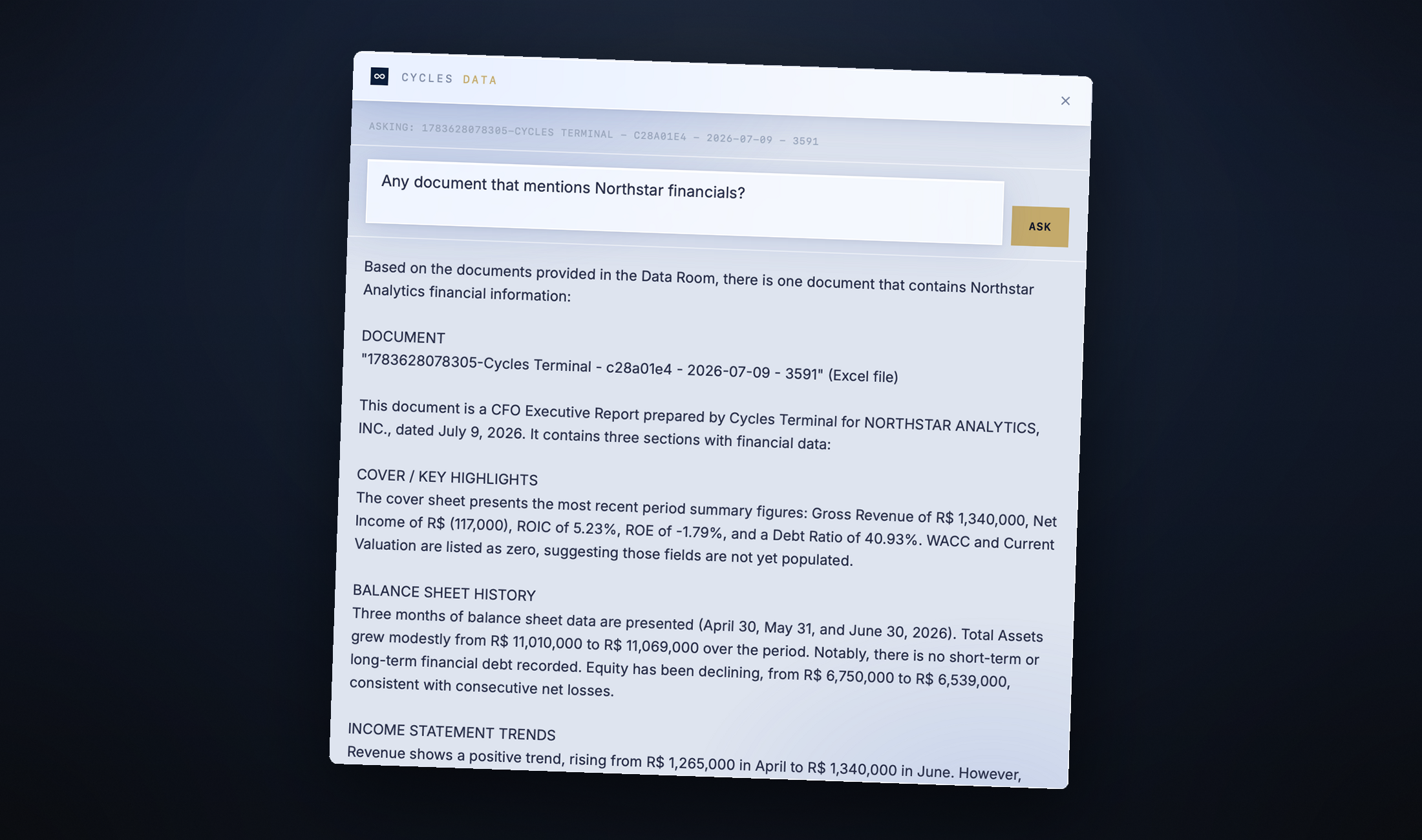
The finance question, answered before the clause is agreed.
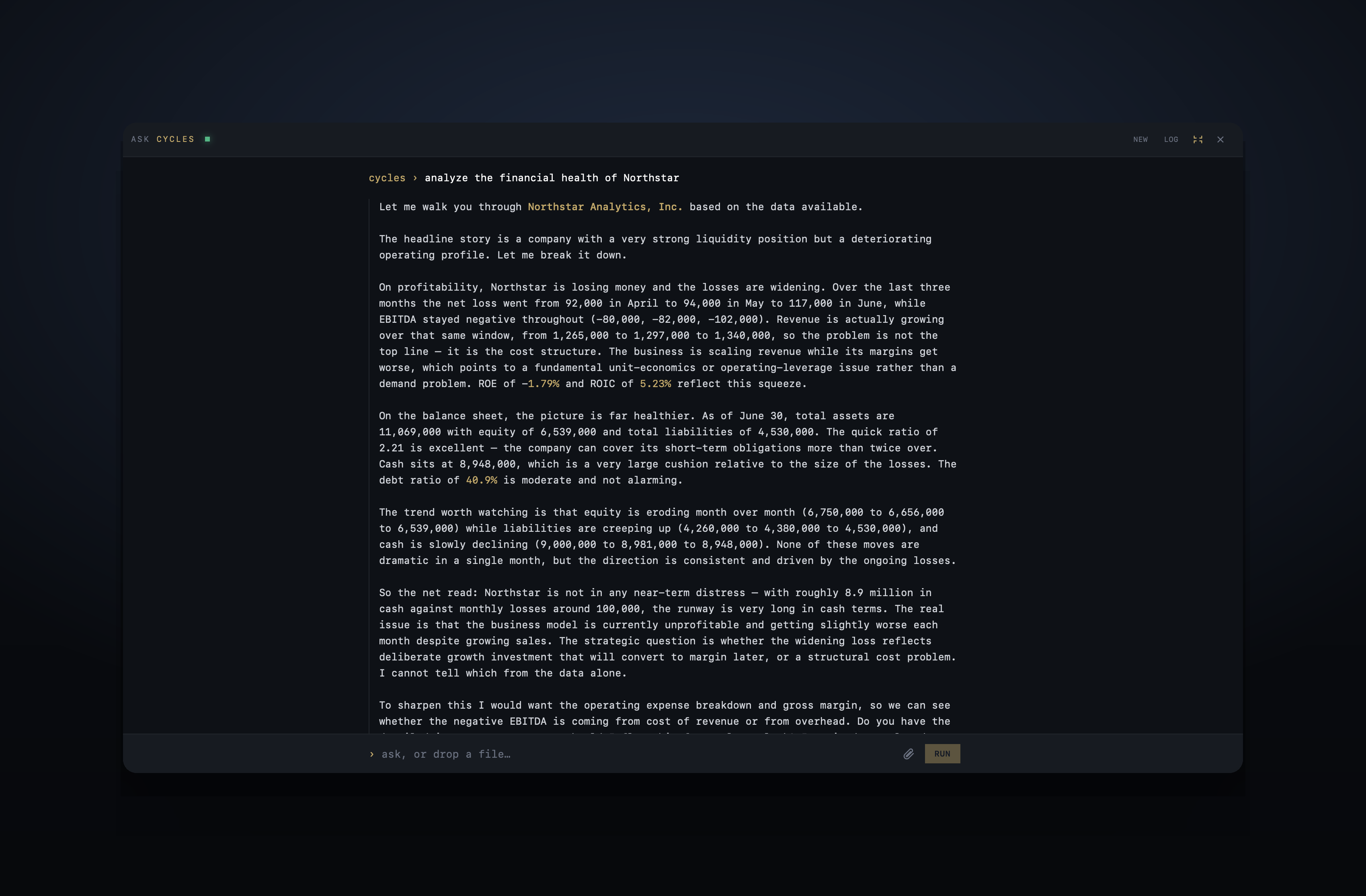
Ask Cycles reads the company's statements and answers in plain language: what the earn-out pays at last year's numbers, how much working capital this business normally carries, whether the company can absorb a settlement of a given size.
It runs on the figures the engine computed, under the same permissions as the person asking — so the answer that shapes a negotiating position can be checked against the statement it came from.
Where it applies.
M&A and shareholder agreements
Diligence findings organised by workstream. Price mechanics modelled before they are drafted. Earn-out and adjustment clauses tested across scenarios.
Partner exit and share appraisal
The valuation behind a withdrawing partner's interest, prepared from the accounts on the methods the matter requires — with the working variables shown, so the figure can be reproduced if it is challenged.
Insolvency — debtor and creditor side
Plan viability assessed, cash runway projected by scenario, and the going-concern position set against the liquidation alternative.
Disputes and arbitration
Lost profits and economic damage quantified, participations valued, each figure sourced. Calculated, not generated — which is the property a contested quantification is judged on.
Ongoing corporate advisory
Client entities read the same way, period after period. Each new period updates the position rather than rebuilding it, and the room stays with the client between matters.
Produced in the formats the work requires.
See it on a real matter.
In a demonstration we load a set of documents into a room, ask across them, and show where each answer came from — the material your judgment is built on.