Every credit decision rests on statements produced by others.
Credit institutions receive financial statements in continuous flow, and each decision depends on trusting figures prepared outside the house. The work does not end at a single reading: it means establishing the reliability of each statement, assessing capacity to pay, and reassessing risk with every new statement — across the whole book.
The analysis a credit decision requires.
Information you can build on
Each statement is assessed for consistency before the analysis begins, so the reading rests on figures that hold together. For periodic analysis of companies.
The credit reading, period over period
Liquidity, leverage, interest coverage, cash generation and average terms computed on each statement. Where the analysis goes deeper, net debt to EBITDA and debt service capacity — the borrower’s trajectory visible across the series.
Borrowers comparable to one another
Because the whole book is read on the same basis, borrowers become comparable, and the movement of each is followed period over period, with the deviation flagged when an indicator deteriorates.
Assessed on entry, comparable across the book.
The borrower’s statement is loaded and assessed for reliability on entry, so a number rests on information that holds together before it informs a decision.
Every ratio traces back to the analysed statement it came from, and every borrower is read on the same basis. It is what sustains a credit opinion when the origin of a figure is questioned in committee.
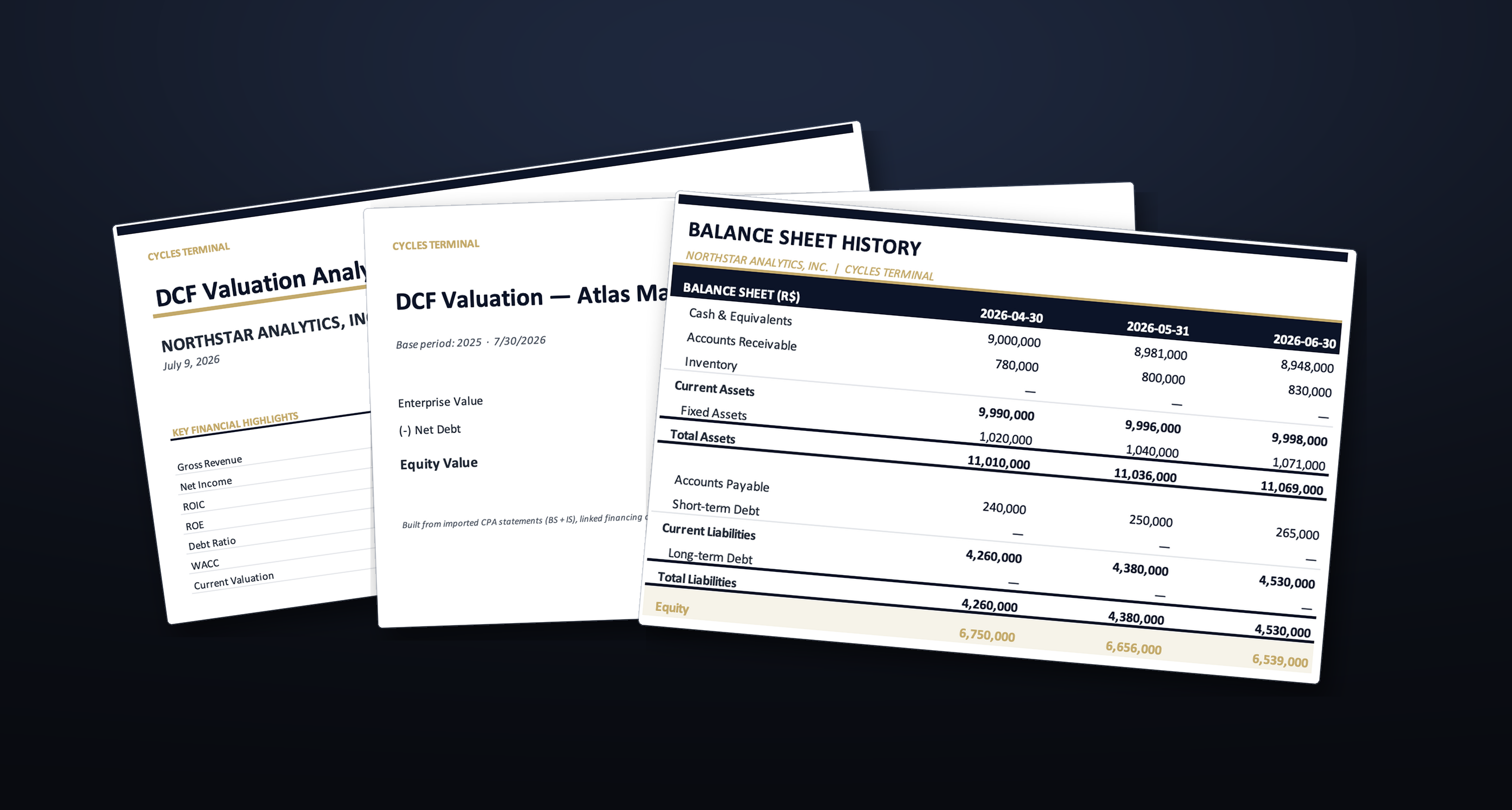
Produced in the formats the decision requires.
See it on a real case.
In a demonstration we analyse a borrower’s statement, compute the ratios, and show Ask Cycles working across them.