Each holding reports differently. The fund has to read them together.
Portfolio companies keep their own accounts, in their own currencies, under their own standards. Reading them consistently — and between reporting cycles rather than only at the close — is what makes a portfolio position current instead of retrospective.
The portfolio, read consistently.
Every company read the same way
Statements, ratios, margins and cash generation computed under one method for each holding. Nothing is merged — each entity keeps the currency and reporting standard of its own accounts.
Current between reporting cycles
Positions updated as statements arrive rather than at the quarter, so a portfolio-level question can be answered when it is asked.
What each holding is worth now
Multiple methods run on each company, producing a defensible range per holding and a value position for the portfolio as it stands.
Comparable because they were read the same way.
Each holding is analysed under one structure while keeping the currency and standard of its own accounts. Nothing is restated — but because every company was read through the same method, the portfolio can be seen as one.
Fund-level economics run from the same base: distribution modelling, the J-curve across the fund life, and returns reported both gross and net.
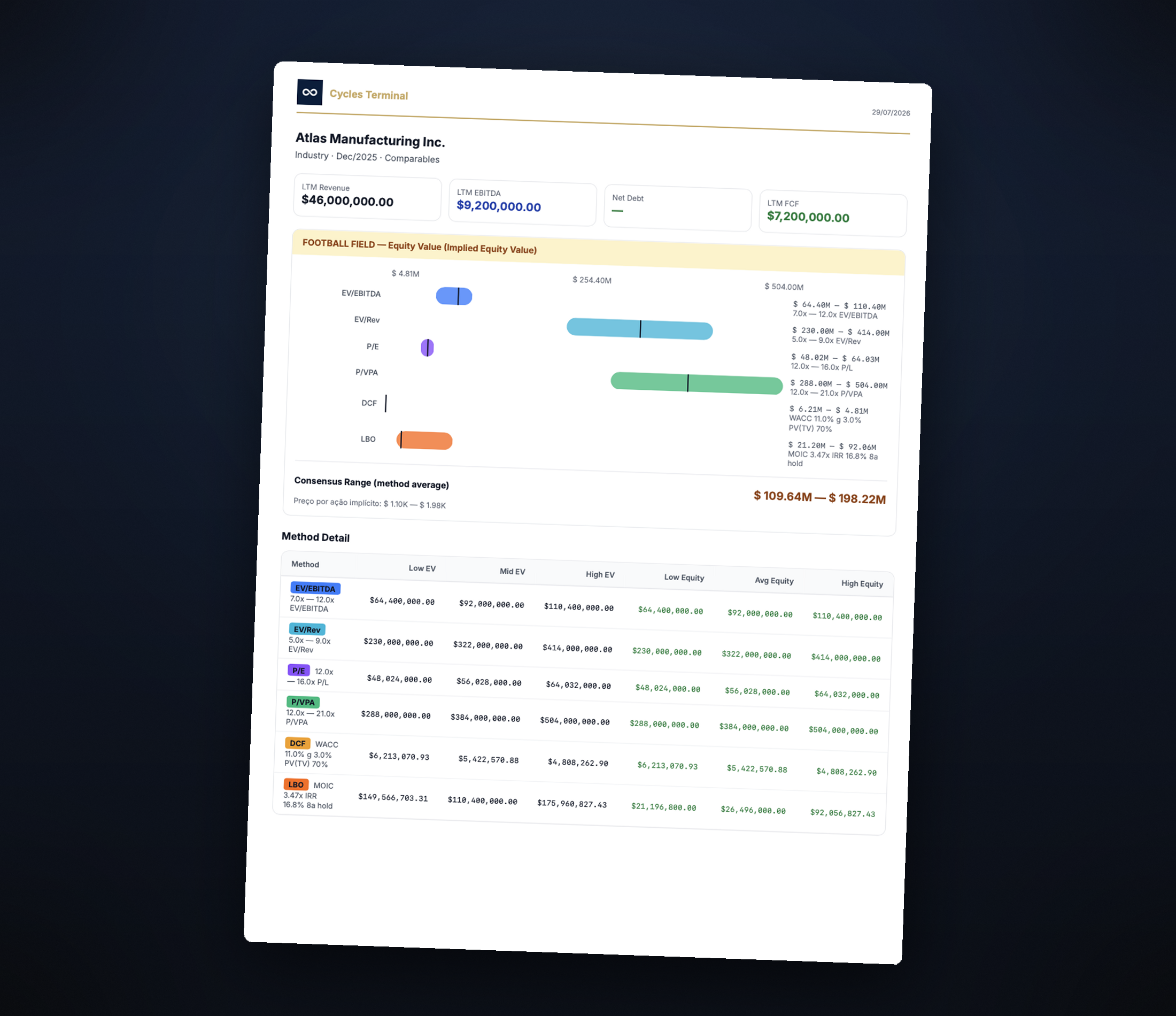
Produced in the formats the work requires.
See it on a real case.
In a demonstration we analyse a company, produce the deliverables, and show Ask Cycles working across them.