Every mandate starts from an empty model.
The structure of a transaction analysis rarely changes. The content always does. What limits how many mandates a firm can carry is not expertise but the hours spent rebuilding the same model for each new target.
The analysis a transaction requires.
Several methods, one range
Intrinsic and relative approaches run in parallel on the same inputs — discounted cash flow, trading comparables, transaction multiples and the investment banking framework — with the dispersion between them visible rather than averaged into a single figure.
Phased, net of integration cost
Cost and revenue streams distributed across the periods in which they materialise, net of the one-off cost of achieving them, with net present value and payback.
Tracked by category, findings flagged
Items organised by workstream with completion and flags, so the position of the review is visible without assembling a status report.
One base, from screening to committee.
Target financials are loaded once. Valuation, synergy case and structure are computed from the same base, so a revised assumption updates every dependent figure instead of requiring a new model.
Each figure traces back to the statement it came from, which matters when the price is examined by a committee, a seller or an investor.
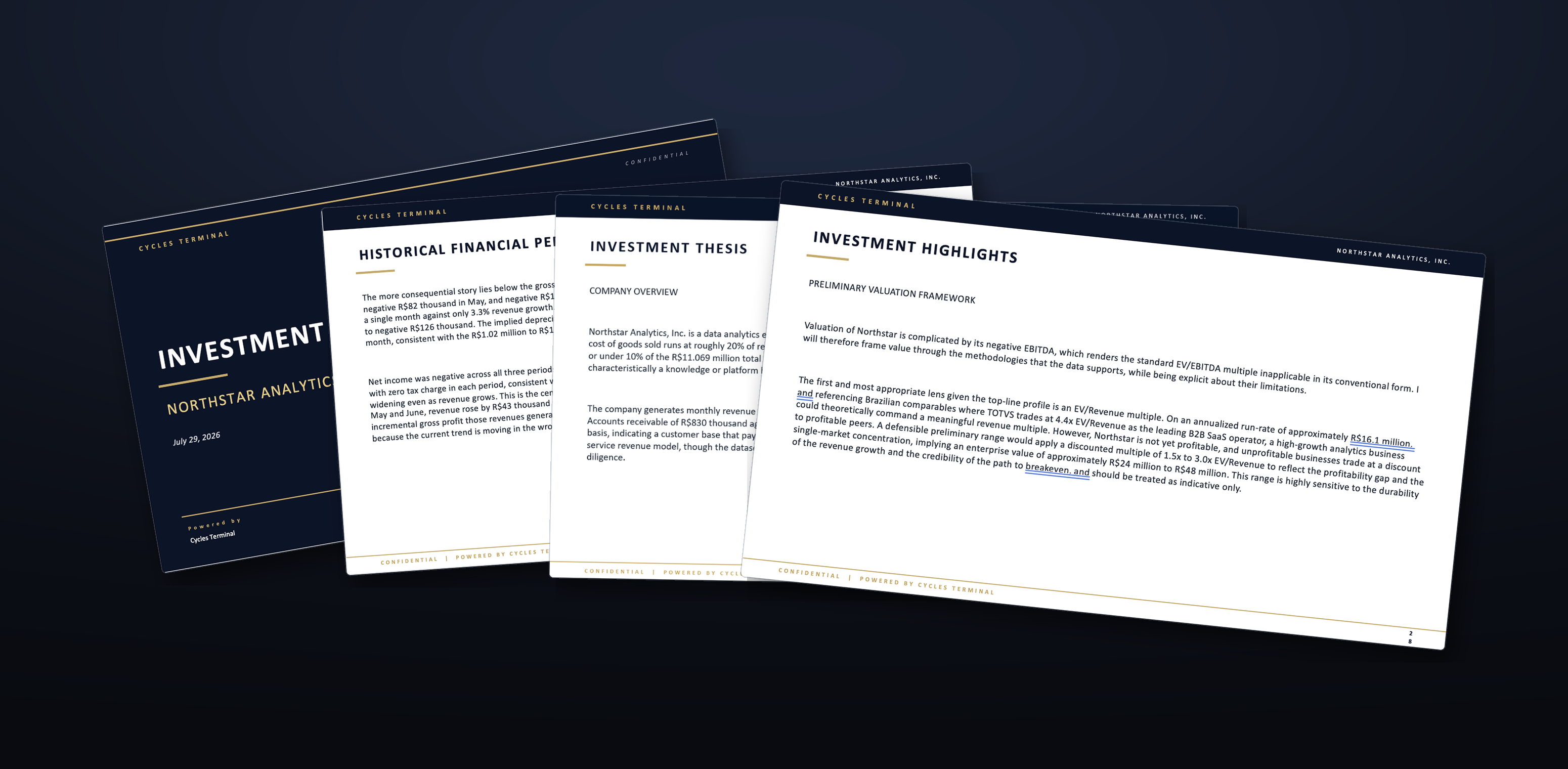
Produced in the formats the work requires.
See it on a real case.
In a demonstration we analyse a company, produce the deliverables, and show Ask Cycles working across them.